
or, Why Billionaires Now Live in Caves While the Rest of us Drown in Stuff.
For the entirety of recorded human history, wealth meant one thing: escape. Escape from the cold, the dark, the uncomfortable or dangerous elements of nature. Civilisations concentrating on putting maximum distance between themselves and the conditions they started in: Roughness replaced by smoothness, darkness by glass and gilding, scarcity by excess. The medieval great halls eventually became Versailles, an entity so gold-leafed and mirrored and manicured that nature itself was rearranged outside the windows into formal reflective geometry. It was expressed by powerful individuals and families increasingly over time: the Habsburgs' jewel rooms of the Residenz in Munich; the Rothschilds, whose extensive collection of Sèvres porcelain existed purely to satisfy an urge to 'collect' whilst also signaling that its owners could afford things that served no purpose except to be exquisite. During the late industrialisation of the twentieth century, Henry Miller had already diagnosed what civilisation has achieved in "the air-conditioned nightmare" : a life hermetically sealed from the elements, everything processed and finished, nothing raw, nothing unmediated. The message across all of it, across all of recorded time, has always been the same: the further from nature, the better. The more processed, polished and refined, the more powerful the signal. Recently this has become no longer true.
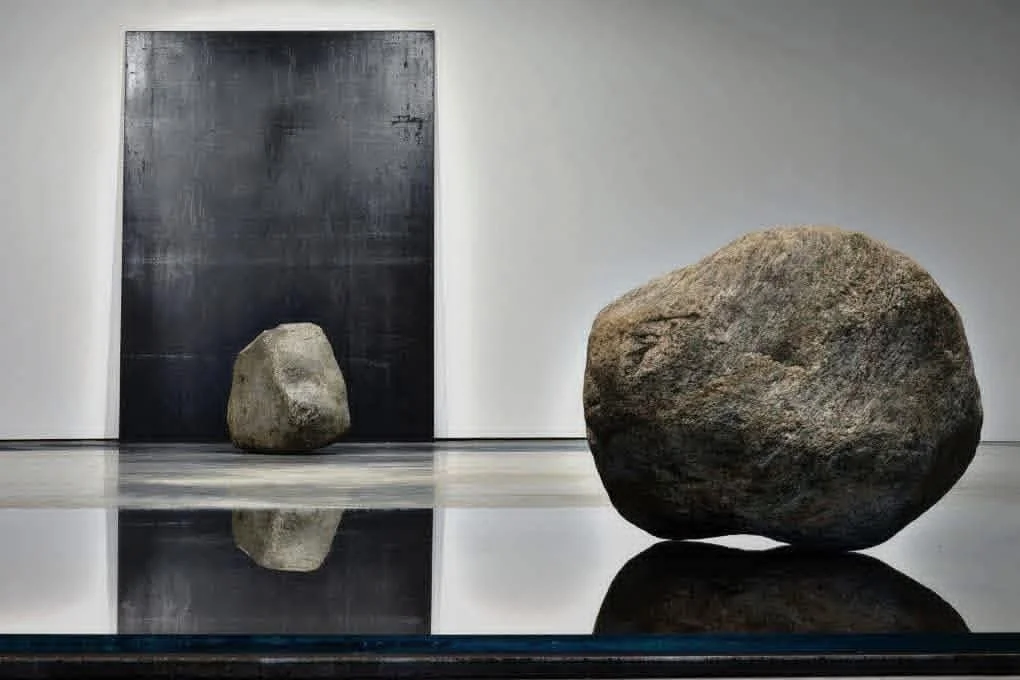
Relatum - Silence (2014) by Lee Ufan
The house Kim Kardashian lives in looks like a cave. Raw concrete, stone, one table, no colour anywhere. Arch Digest called it a "minimal monastery" though the more honest description is it simply looks prehistoric. Designed by the Belgian dealer Axel Vervoordt, who has spent his long career developing this vocabulary: the ancient, the worn, the stripped bare. A Vervoordt interior reads as somewhere starting with a monastic hermitage and going as far as a Neolithic burial chamber. Those who can afford it pay a very great deal to live inside something that often visibly predates everything the Rothschilds ever collected. Rick Owens is a similar example. His Paris home, set inside the former Paris headquarters of the French Socialist Party was gutted completely, stripping the mouldings back to the raw stone. One room has no windows. Others are almost totally empty. He calls it his concrete palace. It is, by any reasonable measure, a cave.
“For the entirety of recorded human history, wealth meant one thing: escape. Escape from the cold, the dark, the uncomfortable or dangerous elements of nature.”
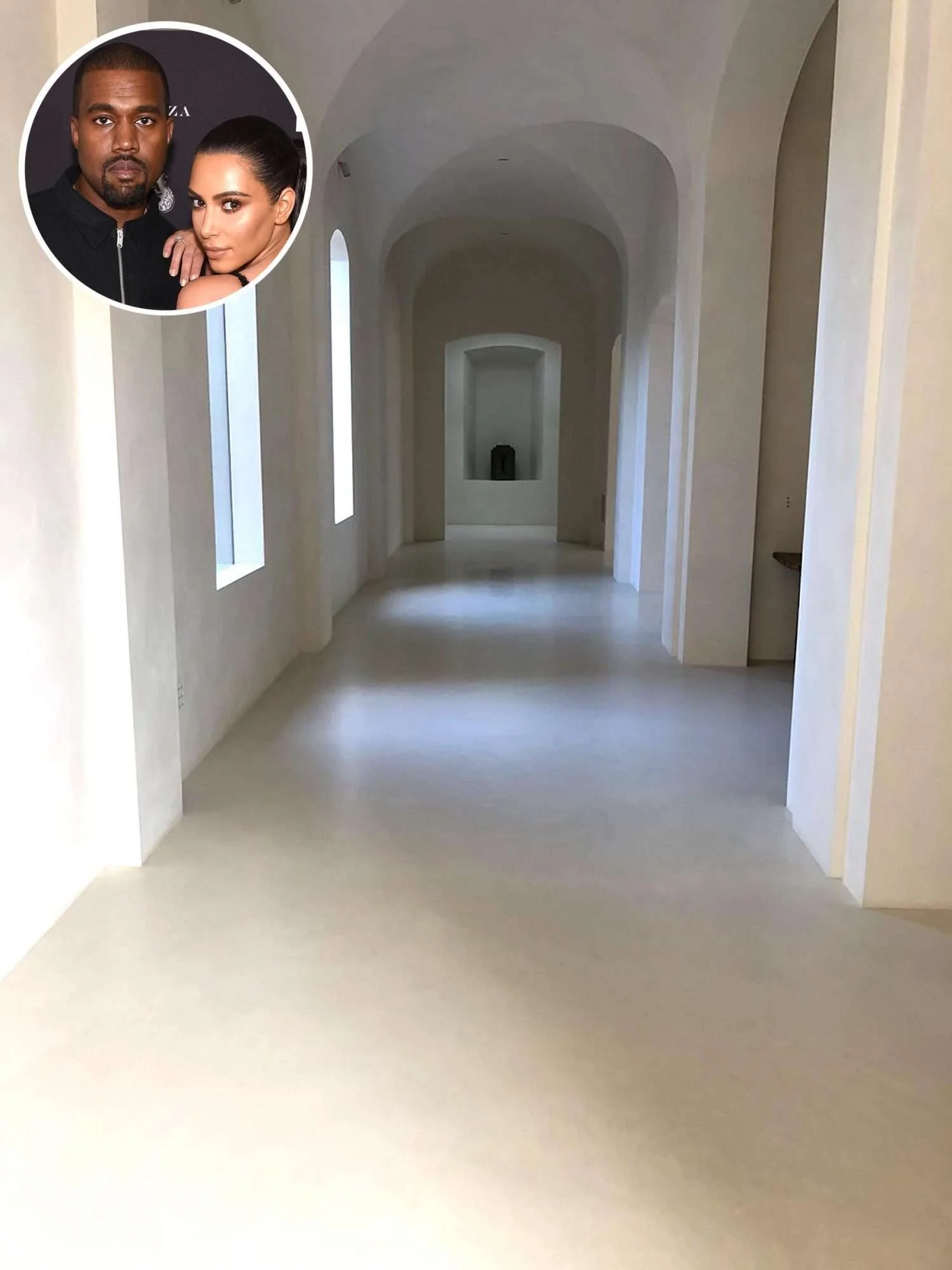
KIM’S HOME. MONK LIKE PRE-HISTORIC AUSTERITY.
Many flats in Peckham -for example- still look nothing like this. They are filled with colour, possessions, and often a huge quantity of excess clothes. There are screens everywhere: a television, a phone, a laptop on the kitchen table, a tablet for Netflix in bed. There is a smart meter and a council tax portal and a parking permit renewal and sixteen subscriptions in various states of forgotten. Notifications and deliveries. More stuff arriving while the still usable older stuff waits to be collected by the rubbish men or taken to the donation bins. This is, more or less, what civilisation has produced at its peak. This is the summit. And looked at plainly, it is not obviously good. It is loud and admin-heavy and faintly suffocating, a life spent managing the abundance rather than living it. Materiality as a lifestyle is one where the stuff has won.
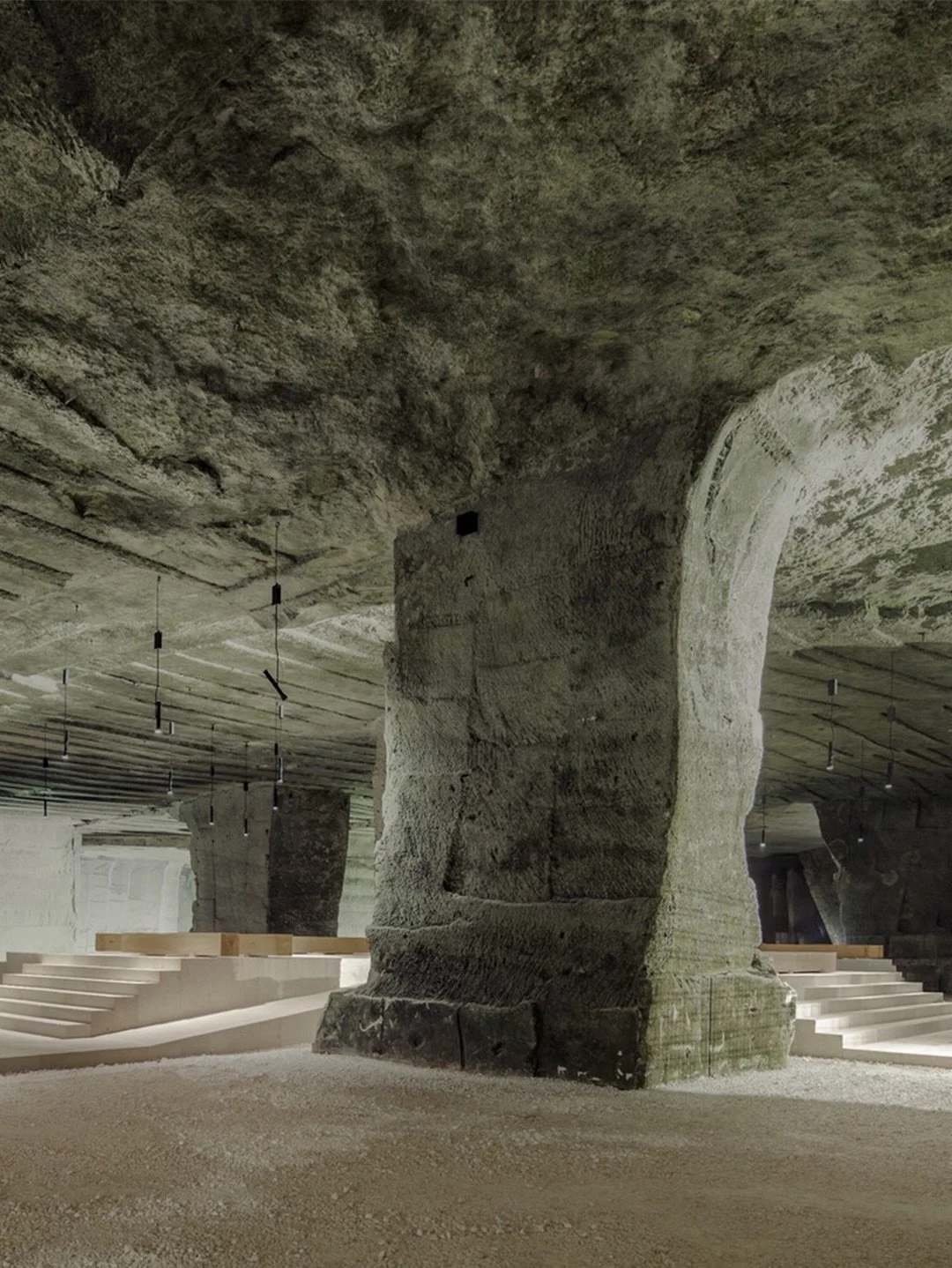
Cava Arcari (also known as Cavea Arcari), a subterranean performance and exhibition space carved inside an old stone quarry in Zovencedo, Italy, designed by David Chipperfield Architects in collaboration with Laboratorio Morseletto.
“The message across all of it, across all of recorded time, has always been the same: the further from nature, the better. The more processed, polished and refined, the more powerful the signal.”
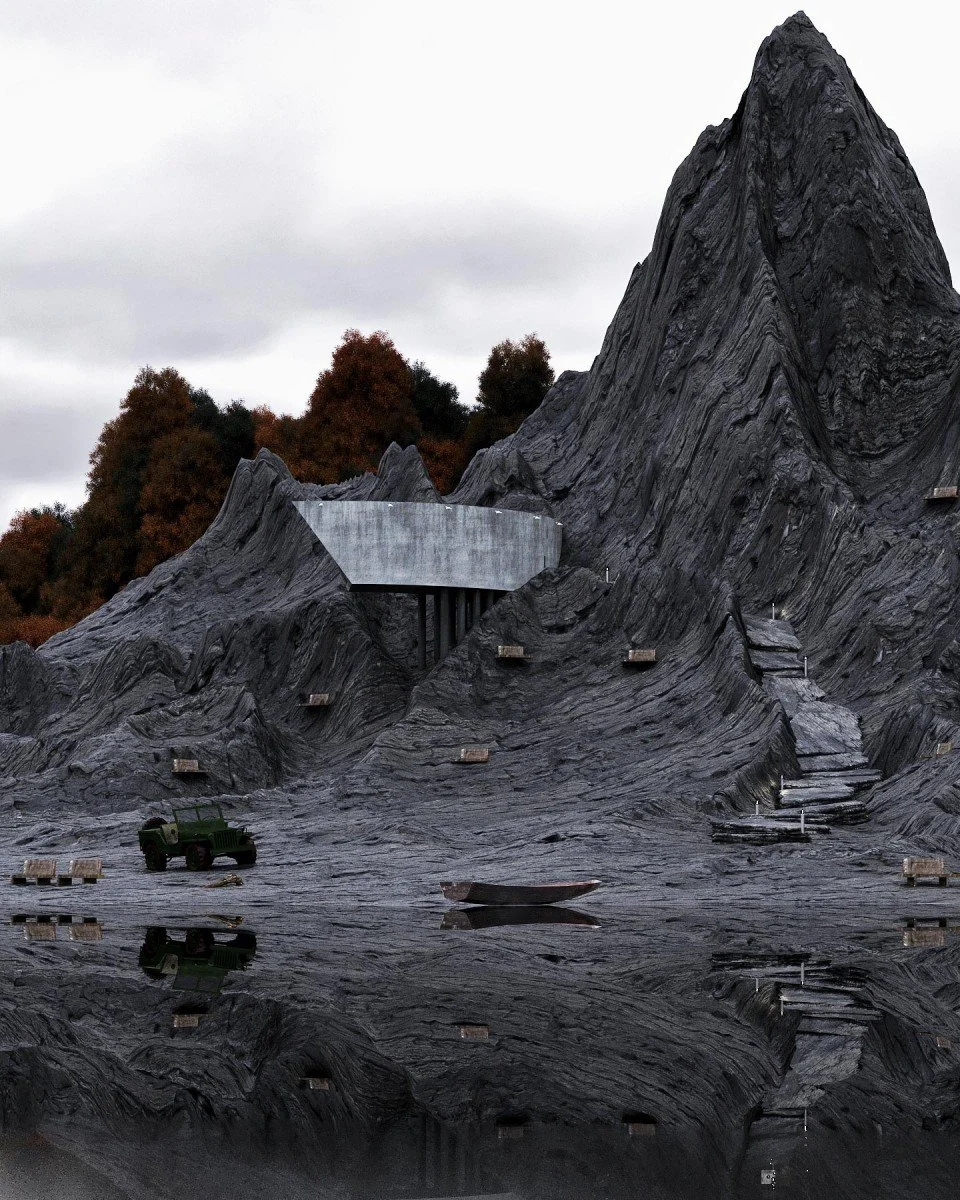
Concrete House, a brutalist architectural concept designed by Iranian architect Reza Mohtasham
Whereas the rich are arranging for themselves not to experience any of this. The emptier and more subdued the space the better. The market reacted: Natural hues are preferred, Coarse woven linen costs more than finely processed linen. The celebrity rich build their bedrooms from unfinished timber, and dine on raw meat and foraged berries. And this is not purely aesthetic. The paleo diet, the carnivore movement, ancestral health, the ice bath - these are philosophically unified by a single and mostly unconscious belief: that modernity made us sick and that the cure is regression. The ancient is not just beautiful; it is correct. The further up the wealth scale you go, the more deliberately primal the lifestyles seem to be becoming. But they are not yet fully rejecting luxury, they are redefining it as something that predates the concept of lavish luxury entirely: Primal Minimalism. It is not the cerebrally stylish and posed minimalism of Donald Judd boxes and the white galleries - that minimalism of the 1960s to 2000s. It goes beyond the twee Mari Kondo interpretation of minimalism as a lifestyle philosophy. No, this is something that predates the entire concept of style or lifestyle gurus altogether. It reaches back past modernism, past the Renaissance, past Rome, past all of it until it lands somewhere around the Palaeolithic. For now, we are witnessing a Paleolithic Luxury period. The PaleoLux. The engine driving this retreat is a trite mechanism: luxury gets copied, gets democratised, loses its signal, and the wealthy go further. But the direction of that retreat is not, as it has always been, toward more industrial technological refinement. It is now pivoting toward truly less refinement. Each year the aesthetic gets rawer, the food less processed, materials used in more unfinished formats, as lifestyle as we once knew it gets deliberately more stripped. The logical endpoint of this trajectory is not a cave-like house. It is a cave.
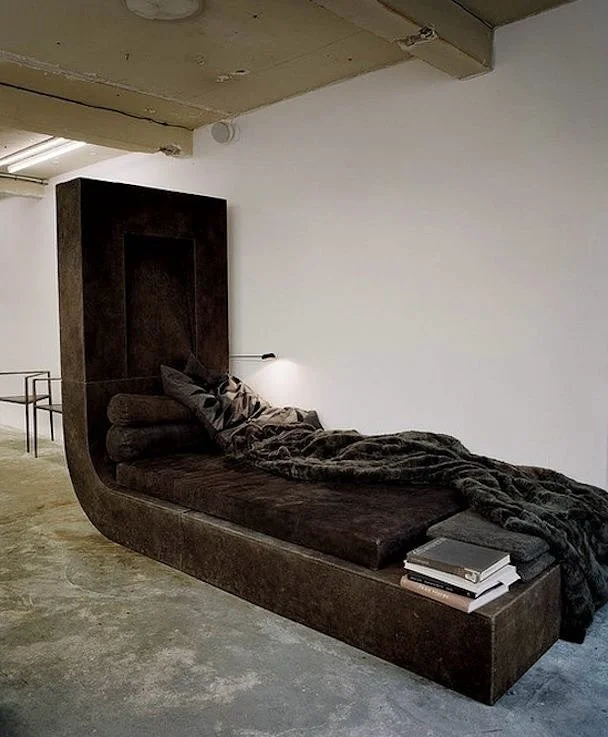
brutalist daybed from fashion designer Rick Owens's Paris home, featuring a striking tall curved headboard and dark upholstery.
“The engine driving this retreat is a trite mechanism: luxury gets copied, gets democratised, loses its signal, and the wealthy go further.”
The arc of civilisation, it turns out, is not a straight line. It is a loop - and this is probably the first moment in recorded history where the wealthiest people on earth stopped moving away from the cave and started moving back toward it. When Material goods became plentiful enough to become a problem and Technology became ubiquitous enough to become a burden. Somewhere at the top of that arc, the people who could afford it- looked around at what had been achieved and quietly began reversing. Now they are building caves again, at considerable expense, in the hills above Los Angeles, perched above Norwegian fjords, buried in mountainsides off the coast of Ibiza, hosting dinners where the foraged, raw ingredients cost three times what the cooked version would, the mammoth tusk more desirable than aerospace grade titanium (I should know, I made some mammoth tusk glasses and yes, they were indeed expensive). It is extraordinarily expensive to live like a person from 30,000 BC. Described to a Roman peasant, such a life would sound bafflingly basic. The king lives where? In a stone room with one table and no colour? He wears fur hides over simple linen? And yet the direction is clear. What does Kim Kardashian do with her next home, remove the hot water system perhaps and only use natural plunge pools to wash? The current cave-house was not the destination. It was one of the first steps back.
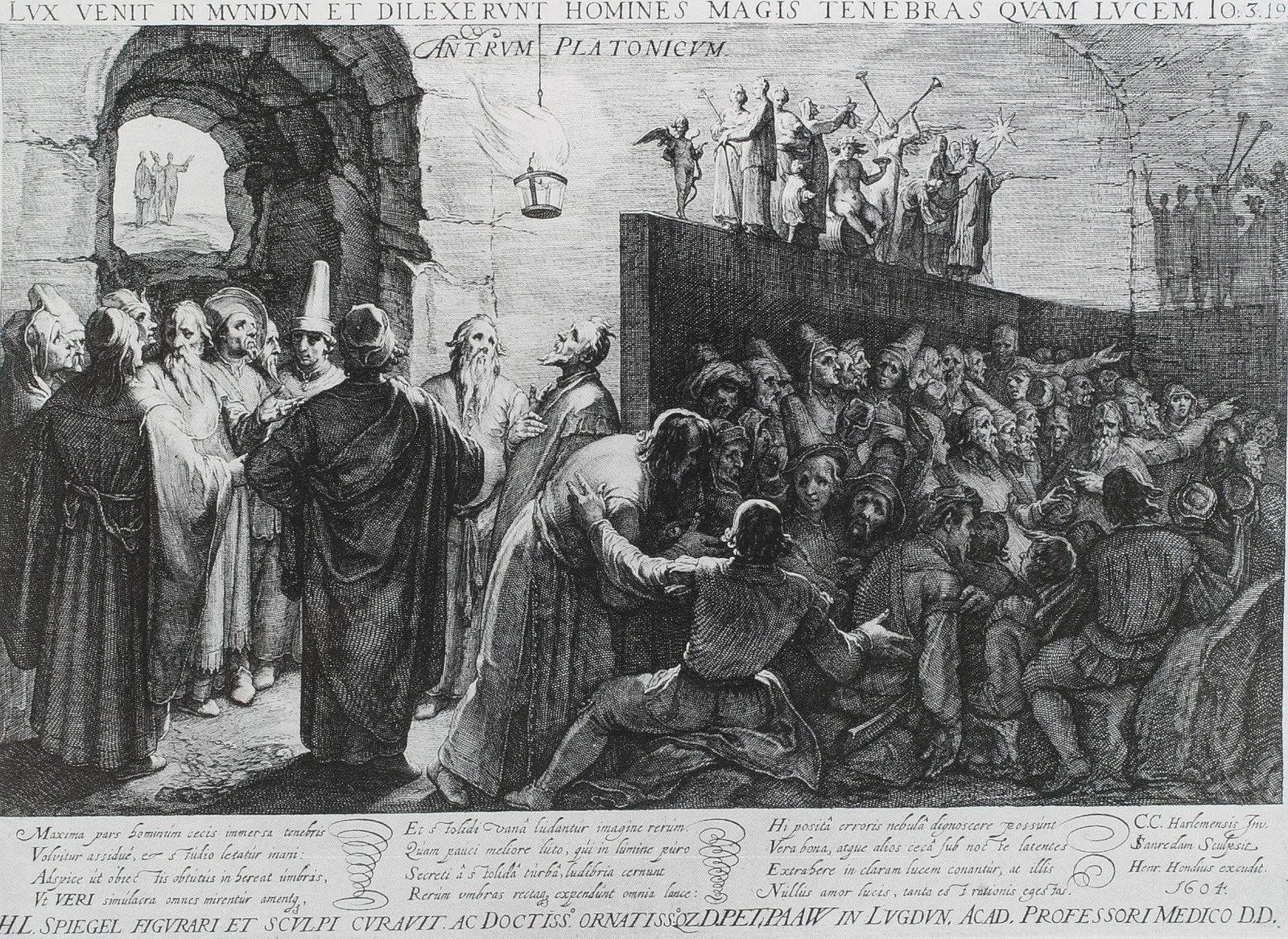
Antrum Platonicum (Plato's Cave), created by Dutch printmaker Jan Pietersz Saenredam after a design by Cornelis Cornelisz van Haarlem (1604)
Which does raise a question about the wild animals and insects. They never left the palaeo life. They have been there the whole time, eating the unprocessed food, sleeping when tired, not managing a subscription to anything or looking for a charger so they can keep scrolling through Zara's Black Friday sale before it ends. When animals first watched man shamble out of cave-dwelling apedom, perhaps they looked on bemused, already knowing where it would end. The animal arrived by instinct. Humanity will eventually arrive there also, possibly represented by only a few billionaires and architects, at considerable expense, and after a very, very long detour — a destination eventually identical in lifestyle to the animal life we once left. The extraordinary thing about civilisation, it turns out, is that it took so much trouble and time to accidentally arrive back at the beginning — and that when it did, perhaps only the very rich could afford to live in a cave.
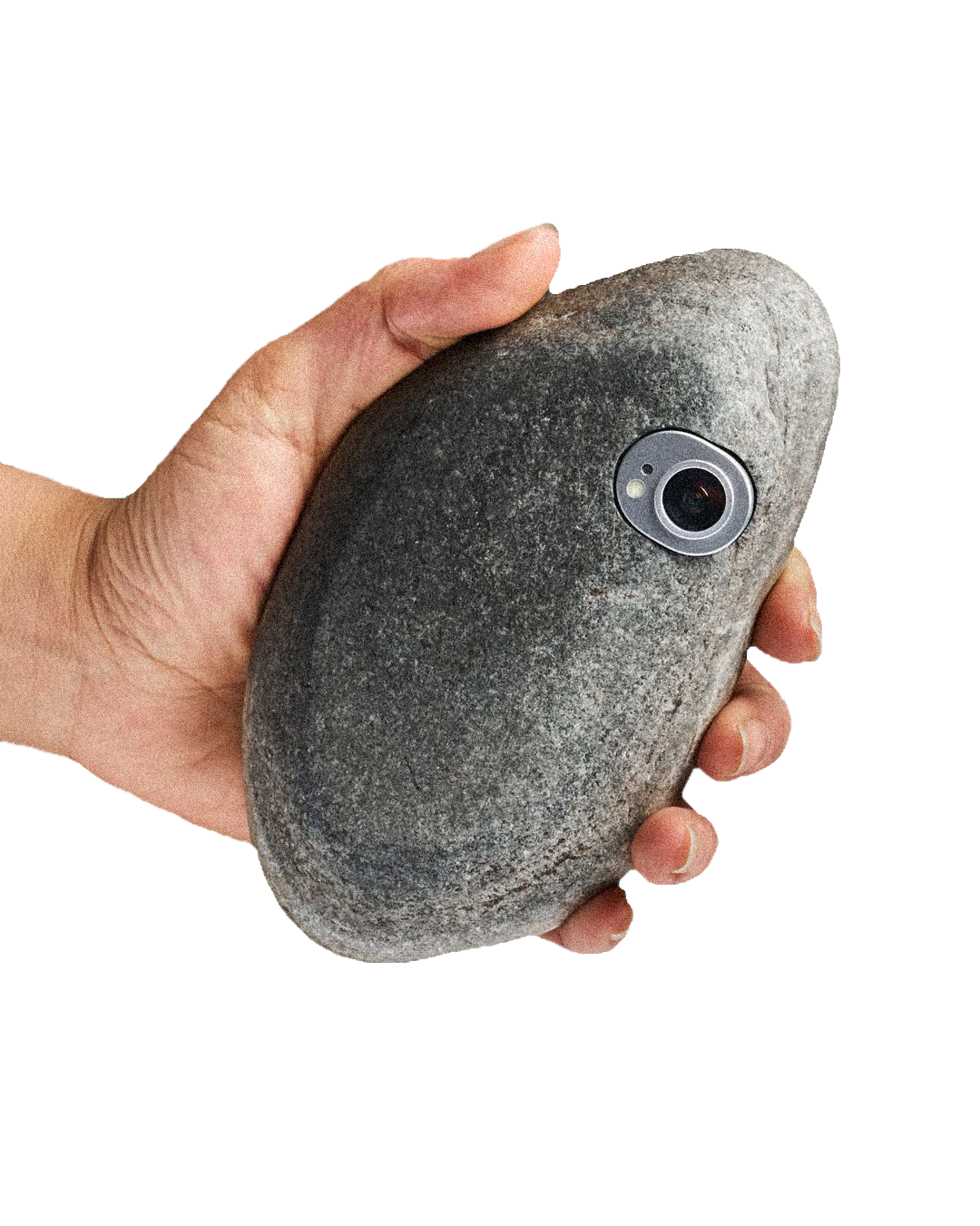
a conceptual mobile device, created as part of the ECAL × Google: A Message From Tomorrow collaboration showcased during Milan Design Week 2026.

Thanks for reading. If this raises questions, disagreements, or alternative perspectives, I’d be interested to hear them.
Comment via Instagram (link in menu) or contact me here.